

Diskless boot solution
Diskless boot for Windows: one image, every PC, no hard drives
Diskless boot replaces the hard disk in every client PC with an image streamed from the CCBoot server. Each machine starts clean on every reboot, updates happen once, and Windows 10, Windows 11 or Windows Server runs at full local speed.
- hard drives per client
- 0
- image to maintain
- 1
- less power per seat
- ~40%
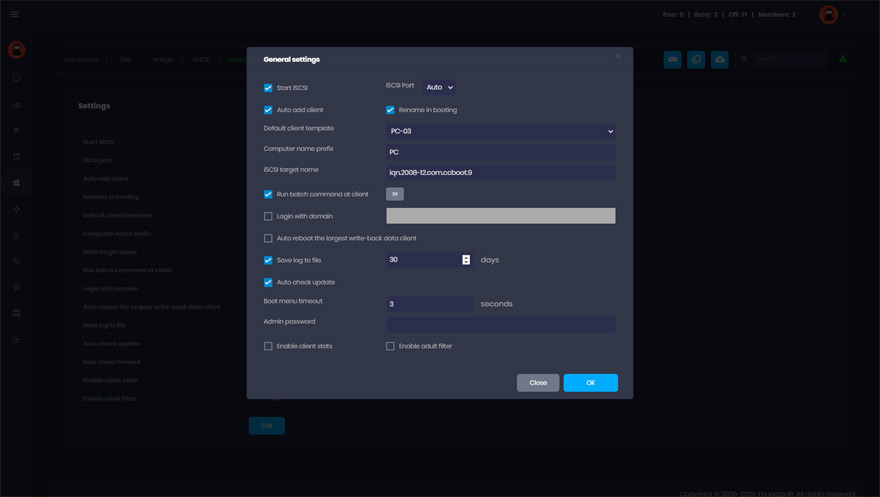
How diskless boot works
Diskless boot is built on IP, UDP, DHCP and TFTP. It needs two sides: the diskless boot server and the client.
- 1
Power on and load BIOS/UEFI
The client is set to boot from the network. The PXE stack built into the NIC takes over instead of a local disk.
- 2
Get an address from the server
CCBoot’s DHCP service answers the request, allocates an IP address and points the client at the boot program.
- 3
Download the NBP over TFTP
The Network Boot Program is copied into the client’s RAM and performs the second-stage boot.
- 4
Mount Windows over iSCSI
The NBP attaches the shared Windows image as the system disk. Writes go to the client’s own write-back area and are discarded on reboot, so every PC comes back clean.
What diskless boot gives you
The same reasons 30,000+ internet cafes, schools and offices run CCBoot.
No More Buying Hard Drives
Client PCs don’t need a hard drive… this alone could save you THOUSANDS of dollars.
No More Viruses, Trojans, and Spyware
The system will be restored after every reboot, leaving your PCs in a clean state at all times.
Easy Updates
When the “master” PC is updated, the rest of the PCs on the LAN will update with a simple reboot.
Save Money On Human Resources
One person can handle updates, maintenance, and software rollouts that used to take multiple people hours… or days.
Energy Conserving
Up to 40% energy could be saved, which is environmental and energy-saving.
Efficient Cache Equipped
Equipped with good cache performance, physical memory, and SSD cache support.
Easy Restore Points
Set restore points such as create recovery, merge to last, and restore to last. This makes it easier to fix problems and maximize performance.
Personal Disk Support Included
Store client data that is never lost on reboot — great for users whose files need to survive beyond a session.
One Image for All Specs
The PnP function makes a single image work on client PCs with different hardware.
Diskless boot on Windows 10, Windows 11 and Windows Server
Current CCBoot releases boot Windows 10, Windows 11 and Windows Server 2019/2022 images on UEFI motherboards with Secure Boot enabled, as well as older PCs in legacy BIOS mode — from the same server, in the same room.
Game disks and data disks are shared over the network too, with RAM and SSD cache on the server so loading stays fast even when the whole room starts the same title at once.
- Super client mode: install updates once, reboot the room
- Restore points: merge good changes, roll back bad ones
- Personal disks for users whose files must survive a reboot
- Hybrid mode: keep a local SSD for the OS, stream only the games
Get Your FREE Trial Today
Download CCBoot, upload one Windows image and diskless boot your first PC today.
Start Your FREE Trial TodayClassic guide: using CCBoot to build a diskless boot server
The original walkthrough, kept in full. It was written for Windows XP-era clients; the server install, DHCP scan and image upload flow are unchanged in current versions.
Diskless Boot Technology Background
Diskless boot is a technology based on IP (Internet Protocol), UDP (User Datagram Protocol), DHCP (Dynamic Host Configuration Protocol) and TFTP (Trivial File Transfer Protocol). It requires two computers: the diskless boot server and the client. The client is a computer you want to diskless boot up on the LAN, while the server is a combination of DHCP server and TFTP server. It responds to requests from diskless stations over the network, allocates IP addresses via DHCP for them, and pushes the necessary data to these stations so that they can boot on the LAN even without a hard disk. CCBoot supports diskless internet cafe and diskless solution cybercafe.
If using a diskless boot solution, the boot process is as below:
- Power on,
- Load BIOS,
- PXE stack built-in the NIC (Network Interface Card),
- Download NBP (Network Boot Program) from server to client's RAM by TFTP,
- NBP's responsibility to perform the next step (a.k.a. 2nd stage boot).
As an administrator responsible for a network of about dozens of computers or more, a diskless boot program will drastically reduce your daily workload. If you want to install or upgrade various software for all computers in the network, you just need to do it one time and all computers get changed. It also brings you enhanced Disaster Recovery: all computers get into a clean OS after reboot.
Benefits of Diskless Boot Solution
- Reduce initial capital and implementation costs, reduce power and cooling requirements, reduce complexity and risk.
- Accelerate deployments, upgrades, and server repurposing.
- Implement enhanced Disaster Recovery solutions.
Using CCBoot to Build a Diskless Boot Server
A. Install Diskless Boot Server with CCBoot – An all-in-one Diskless Boot Software
Download diskless boot software – CCBoot server installation package from www.ccboot.com/download.htm. Launch ccbootsetup.exe on the diskless boot server and keep pressing the Next button to the end.
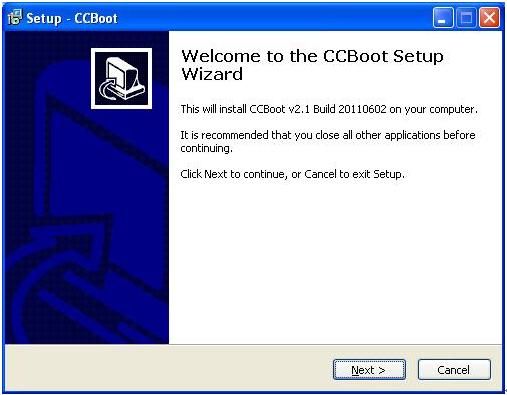
CCBoot will use the following ports – 67 (DHCP), 69 (TFTP), 3260 (iSCSI), 1000 (Image Upload), 8001 (Service Control). You need to open these ports in the firewall of the diskless boot server. Since CCBoot v2.1, you also need to open port 66. V2.1 uses port 66 as DHCP backup.
Note: Please shut down the other DHCP services on the LAN, especially the DHCP service in the router.
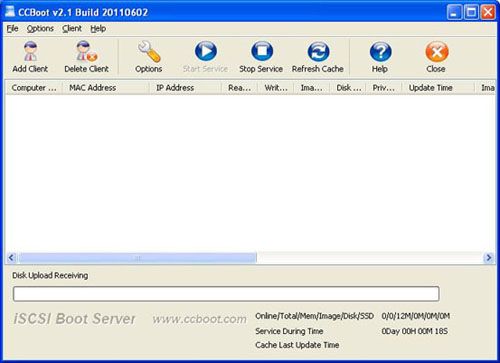
Launch CCBoot and you will get the main interface as below:
B. Initialize the Diskless Boot Server
Demo environment
- Server IP: 192.168.1.10
- Gateway: 192.168.1.1
- DNS address: 192.168.1.1
- IP mask: 255.255.255.0
- DHCP range: 192.168.1.101 – 192.168.1.254
Launch the diskless boot software – CCBoot, open the menu “Options” → “Options Wizard” and configure step by step as below:
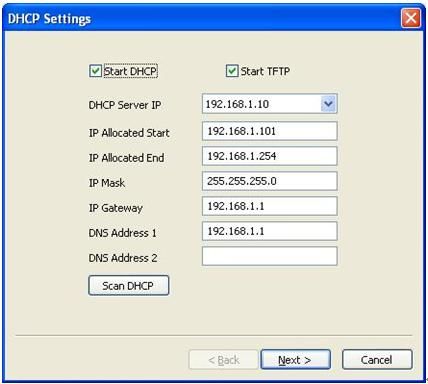
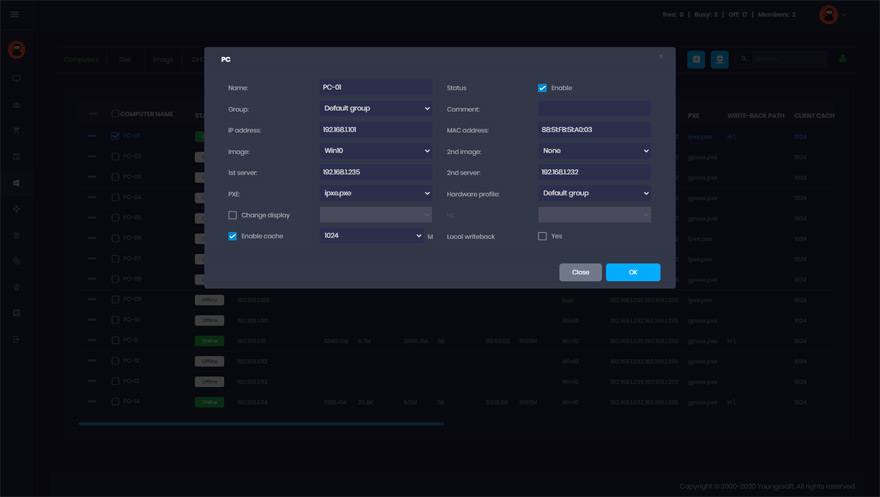
You need to select the correct local IP address as “DHCP Server IP”. Press “Scan DHCP” to check if there are other DHCP services on the LAN. You need to stop other DHCP services on the LAN.
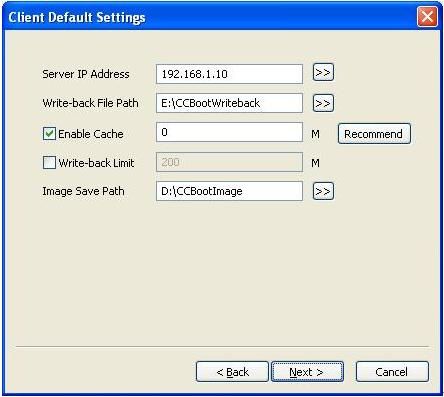
Set “Server IP Address”. Normally, it’s the same as “DHCP Server IP”. Set “Write-back File Path” and “Image Save Path” as you want.
“Write-back File Path” is used to store the diskless booted clients’ write-back data. You’d better use a big-volume hard disk as “Write-back File Path”. This disk should be formatted as NTFS with 64K bytes per cluster.
“Image Save Path” is used to store the images for diskless booting. This disk should also be formatted as NTFS with 64K bytes per cluster. You’d better use a fast hard disk as “Image Save Path”, for example an SAS hard disk.
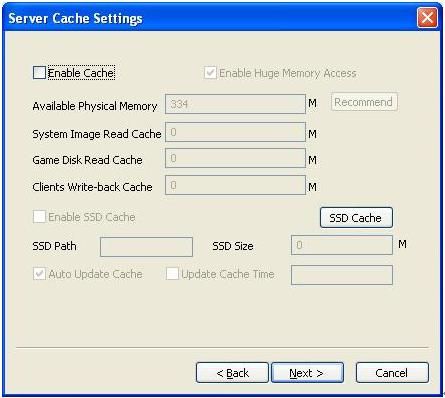
Keep the default values in “Server Cache Settings”.
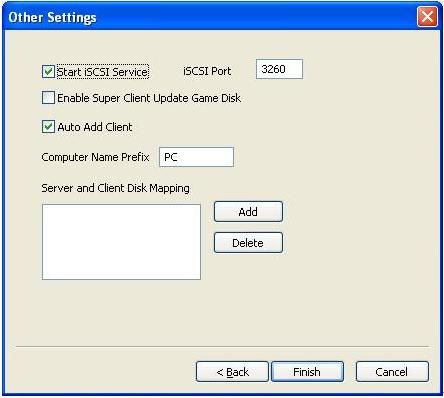
Keep the default values in “Other Settings”. Press the “Finish” button and confirm the popup dialog box.
C. Create an Image for Diskless Boot Windows XP
To diskless boot Windows XP with CCBoot, you first of all need to create a system image. Here are the steps:
- Choose one client PC as the master PC used to create the diskless boot image. Attach a hard disk to the PC.
- Delete all partitions first. Allocate a small MBR partition of about 40 GB and leave the rest unallocated. Format the 40 GB partition with NTFS. Install Windows XP and the latest SP into this partition.
- After completing the Windows installation, open the local area connection network properties and configure as below:
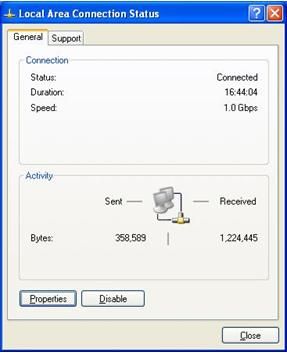
Figure 7 Click “Properties”.
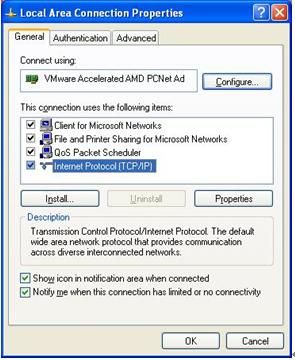
Figure 8 Select “Internet Protocol (TCP/IP)” and click “Properties”.
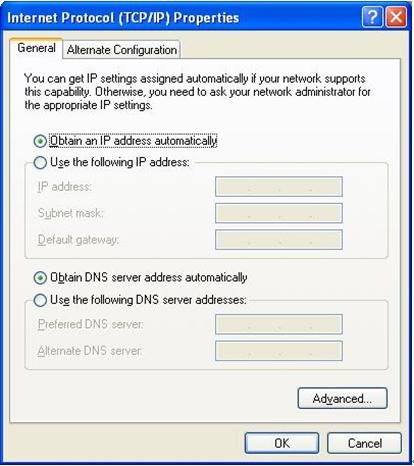
Figure 9 Select “Obtain an IP address automatically” and “Obtain DNS server address automatically”, then click “OK” to save.
- On the CCBoot diskless boot server you will find a client in the client list (Figure 10) that was added by CCBoot automatically when the client PC got an IP address from the CCBoot DHCP service.
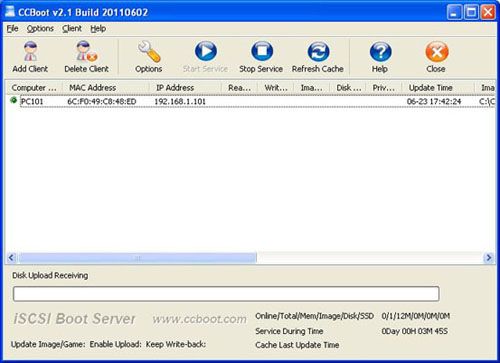
Figure 10 - Double-click the client to edit it and check both “Enable Upload Image” and “Keep Write-back File” (Figure 11). When you press the “Save” button it will ask “Are you sure to delete write-back file?” – just press “No”.
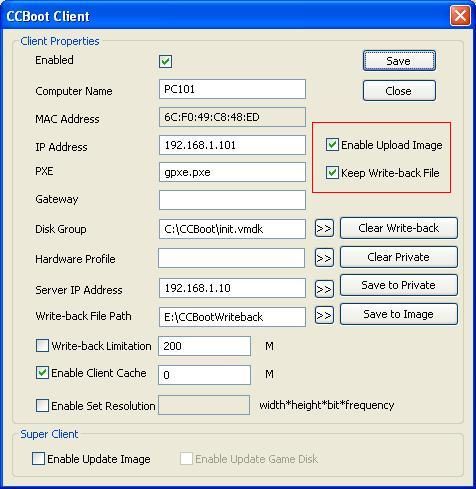
Figure 11 - Download the CCBoot client installation package from www.ccboot.com/download.htm. Launch
ccbootsetupclient.exeand keep pressing the Next button to the end. Then launch CCBoot client and you will see the main interface as below (Figure 12).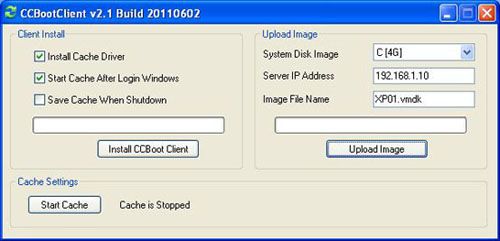
Figure 12 - Press the “Install CCBoot Client” button. After it has finished, it will require a system reboot. Reboot the client PC.
- After the reboot, launch CCBootClient again and input the correct “Server IP address” – it should be the IP address of the PC on which CCBoot server is located. Input the image file name you want in “Image File Name”. Press the “Upload Image” button to upload the image to the CCBoot server. CCBoot will then create an image in the server’s “Image Save Path”.
Note: CCBoot supports two image file formats. It supports VMDK if you are using Windows 2003 as the CCBoot server system, and both VMDK and VHD if you are using Windows 7 or Windows 2008. As you can see in Figure 12, the file format depends on what you have set for “Image File Name”, for example “XP01.vmdk” or “XP01.vhd”.
D. Diskless Boot Windows XP on the LAN
- On the CCBoot diskless boot server, double-click PC101 (Figure 10) to open the master PC’s properties dialog box, and uncheck “Enable Upload Image” and “Keep Write-back File”.
- Remove the HDD from the master PC and set it to boot from the network first (or LAN, PXE ROM, or a similar setting) in the BIOS so that it will start to diskless boot Windows XP (Figure 13).
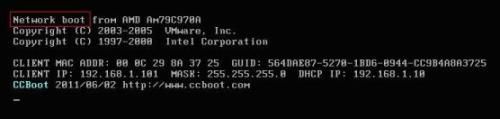
Figure 13 - The first time you diskless boot Windows XP on the master PC, you can modify its computer name (Figure 14).
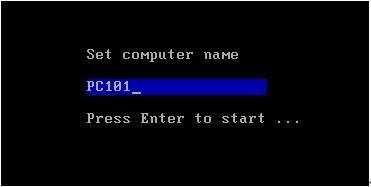
Figure 14 Set the computer name as you wish, then press the Enter key to boot it over the network (Figure 15).
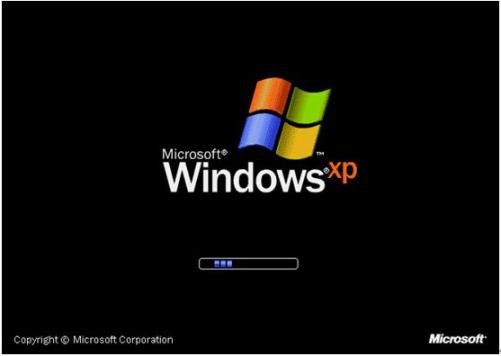
Figure 15 - On the CCBoot server, open “Options” → “Settings” → “Default Client Settings” → “Disk Group”, press the “>>” button and select “XP01.vmdk” as the default boot image in the “System Image Selection” section.
- Repeat Step 2 and Step 3 for the other client PCs with the same specifications as the master PC to diskless boot Windows XP on them.
E. Diskless Boot Windows 7 and Vista
Documentation
Step-by-step guides from the CCBoot wiki.
- Server requirementsCPU, RAM, NVMe cache and NICs for 50–200 clients.
- Client requirementsWhat a diskless client needs: NIC, RAM, UEFI settings.
- Create boot imageInstall Windows on a master PC and upload the image.
- Super clientUpdate the image once and roll it out to every PC.
- Restore pointsKeep, merge or roll back image changes safely.
- Disk cache settingsTune RAM and SSD cache for image and game disks.
- Write-back disk optimizationSSD layout for per-client write-back data.
- Diskless speed issuesTroubleshooting slow boot or game loading.
Common questions
What is diskless boot?
Is a diskless PC slower than one with an SSD?
What happens to files users save?
Does diskless boot work with Windows 11 and Secure Boot?
How many PCs can one server boot?
Can I keep a local SSD and still manage the room centrally?
Are You Ready To Give CCBoot A Try?
It only takes a few minutes to give CCBoot a try… (You’ll be glad you did)